
A Structured Path from Idea to Impact
We don't advise — we co-develop. Our approach moves opportunities from early-stage diagnosis through capital structuring, grounded in our Opportunity Readiness Level framework.
Why This Work Matters Now
The Commodity Hourglass &
The Sovereignty Wedge
The North American food system has been engineered into a paradox: regions that grow food cannot afford to eat it. Commodity agriculture funnels production upward through a narrow hourglass of consolidation — a handful of processors, distributors, and retailers — and then redistributes it back to the regions that grew it, at a markup that extracts wealth rather than building it.
The result: in many rural regions, communities that produce the majority of the food supply import up to 90% of what they eat. The infrastructure that once connected farm to fork — the abattoirs, the grain mills, the regional distributors, the co-operative cold chains — has been systematically dismantled in favor of centralized efficiency that serves shareholders, not communities.
But a structural counter-movement is underway. Across North America, small-to-midsize farms, regional processors, and community food enterprises are rebuilding the Missing Middle — the distributed infrastructure that makes regional food sovereignty possible. They do not need to capture the entire market. A 5% pivot in regional food purchasing — the Sovereignty Wedge — is sufficient to anchor a viable regional food economy.
Regensa's work sits precisely at this inflection point: identifying the farms, enterprises, and supply chain nodes that are structurally positioned to hold that wedge, and building the readiness and capital pathways that allow them to do so without being absorbed or displaced by the system they are replacing.
of food imported back to some rural regions that grew it
regional purchasing pivot needed to anchor a viable local food economy
the Valley of Death where most regional food enterprises stall
Beyond Technology
The Full Picture of Readiness
In the mid-1970s, NASA developed the Technology Readiness Level (TRL) scale to assess innovations for flight. While TRL is excellent for hardware, regenerative agriculture requires more than just a functional tool — it requires a functional ecosystem.
Our Opportunity Readiness Level (ORL) framework extends NASA's logic by integrating three additional pillars: Market traction and demand, Management capability and team strength, and Money — financial structure and capital strategy.
Technology
Does the tool or method work reliably at the scale needed?
Market
Is there verified demand, willing buyers, and a path to distribution?
Management
Does the team have the capability and structure to execute?
Money
Is the financial model sound and the capital strategy staged appropriately?
The Valley of Death
The regenerative agriculture sector faces a structural capital gap. Grant funding typically stops at Readiness Level 3 (concept validation), but commercial finance won't engage until Level 6 (proven operational model).
Grant funding zone
Valley of Death — Regensa's focus
Commercial finance zone

Archer's Target™
Reverse Concentric Iterative Funnel
How We Look at Opportunities
Most due diligence works like a sieve: opportunities are pushed through
a checklist and most are rejected. We use Constructive Discovery instead—working with
values‑aligned teams to refine the concept, de‑risk the structure, and move it step by step up the readiness staircase until it’s genuinely investable.
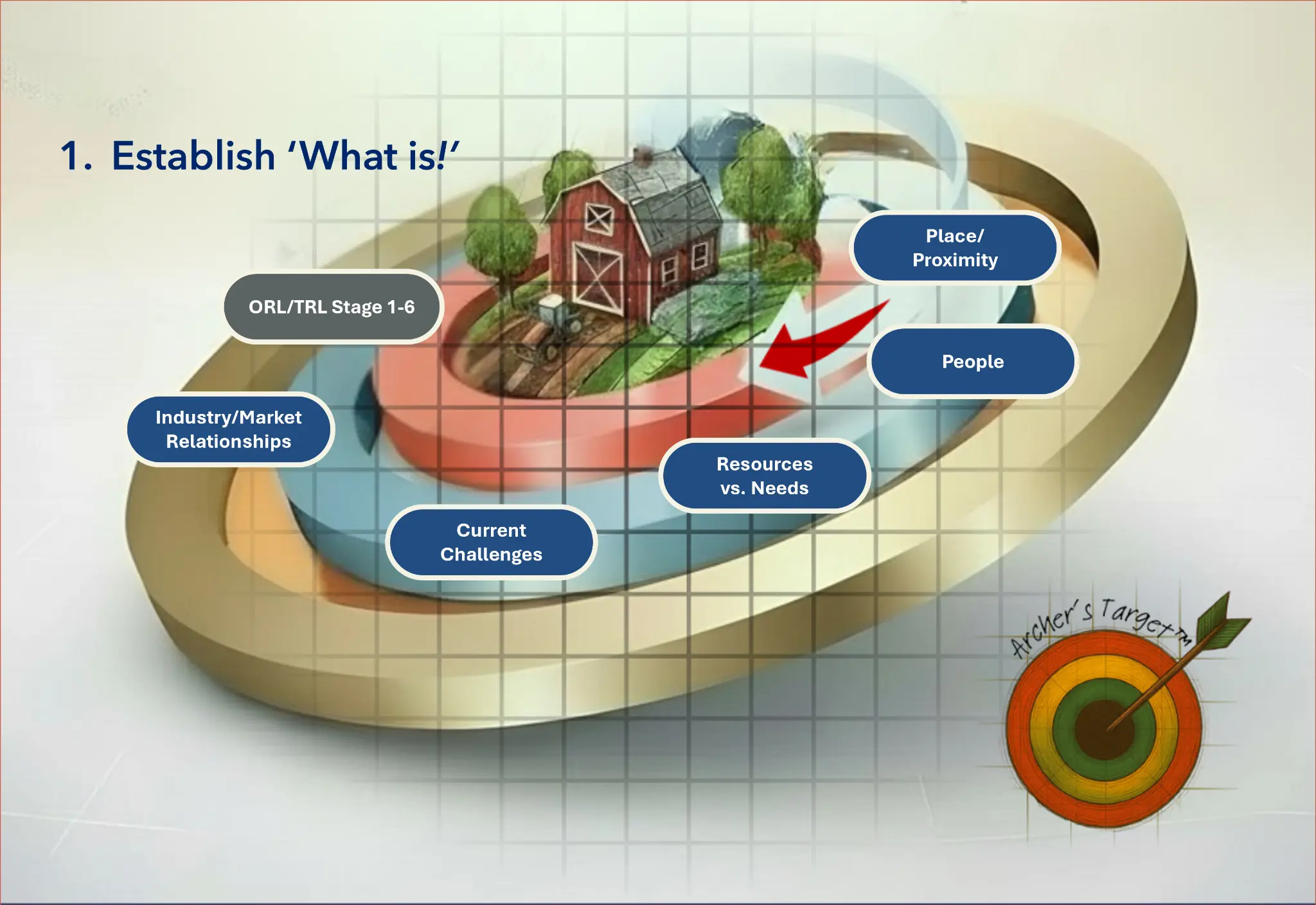
Phase I
Establish 'What Is!'
The Imaginary Discovery Grid maps the current reality: Place/Proximity, People, Resources vs. Needs, Current Challenges, Industry/Market Relationships, and ORL/TRL Stage 1–6.
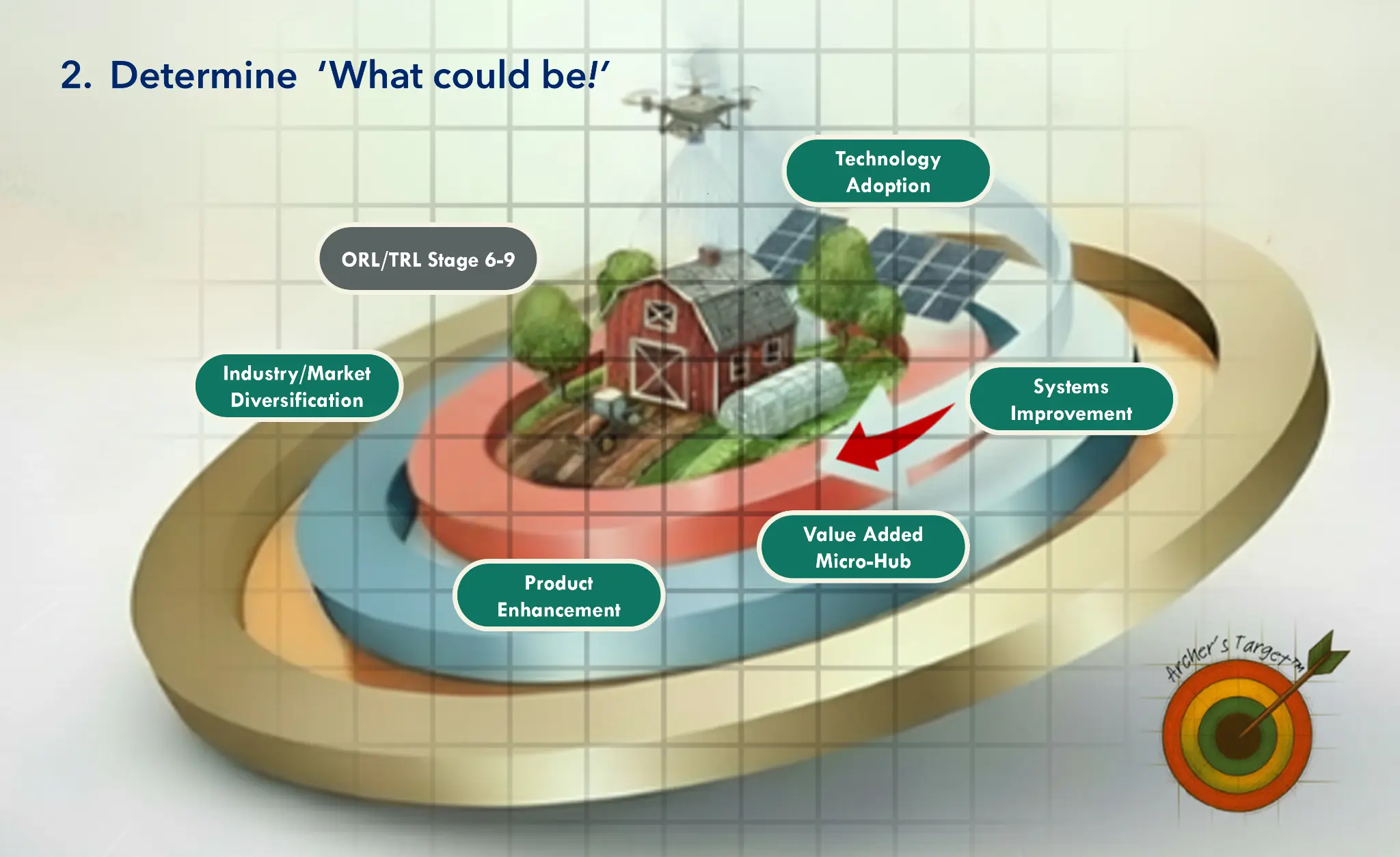
Phase II
Determine 'What Could Be!'
Expanding the aperture to ORL/TRL Stage 6–9: Technology Adoption, Systems Improvement, Value Added Micro-Hub, Product Enhancement, and Industry/Market Diversification.
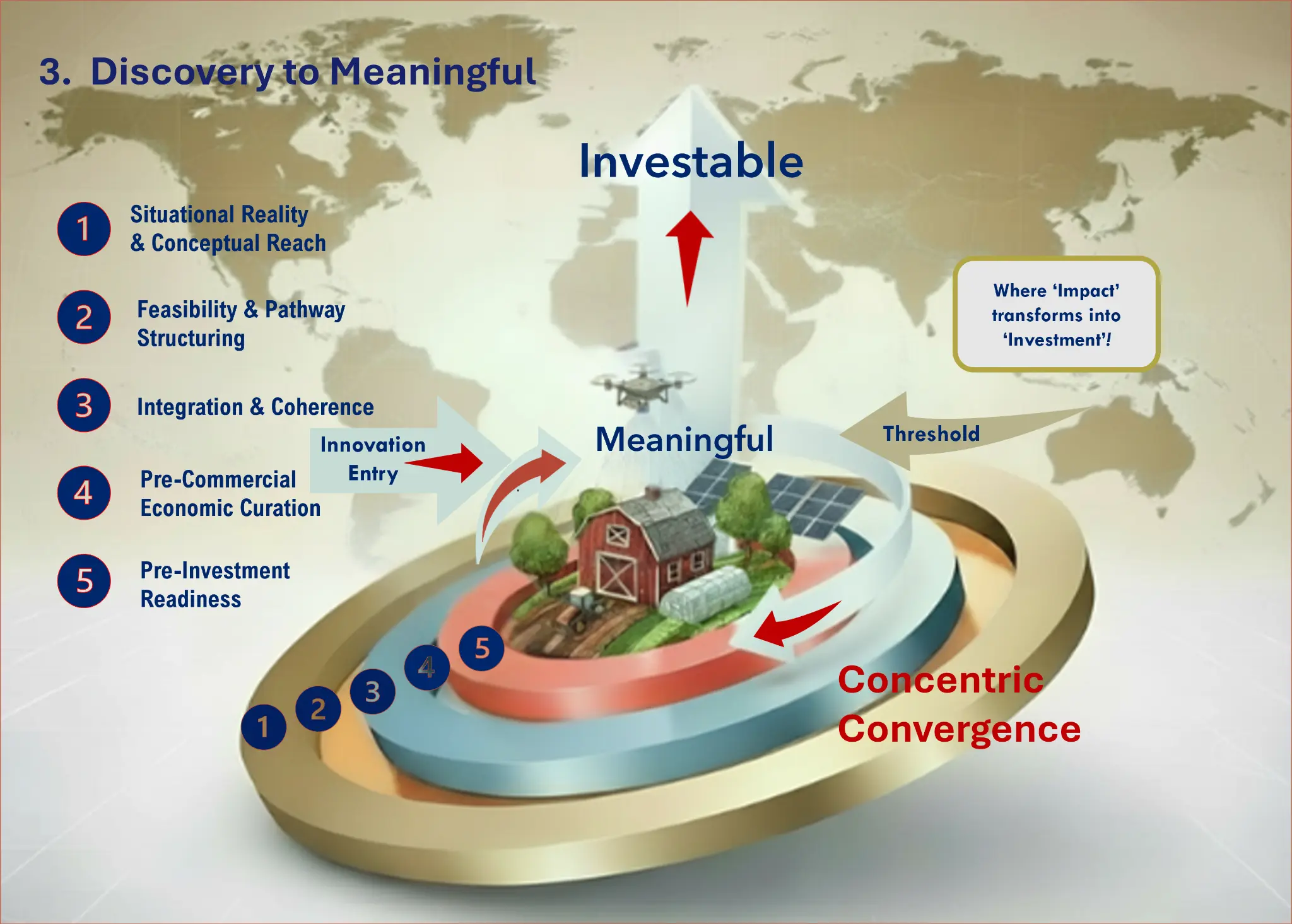
Phase III
Discovery to Meaningful
Five concentric stages of Constructive Discovery — from Situational Reality through Feasibility, Integration, Pre-Commercial Curation, and Pre-Investment Readiness — converging on 'Investable'.
From Meaningful to Investable
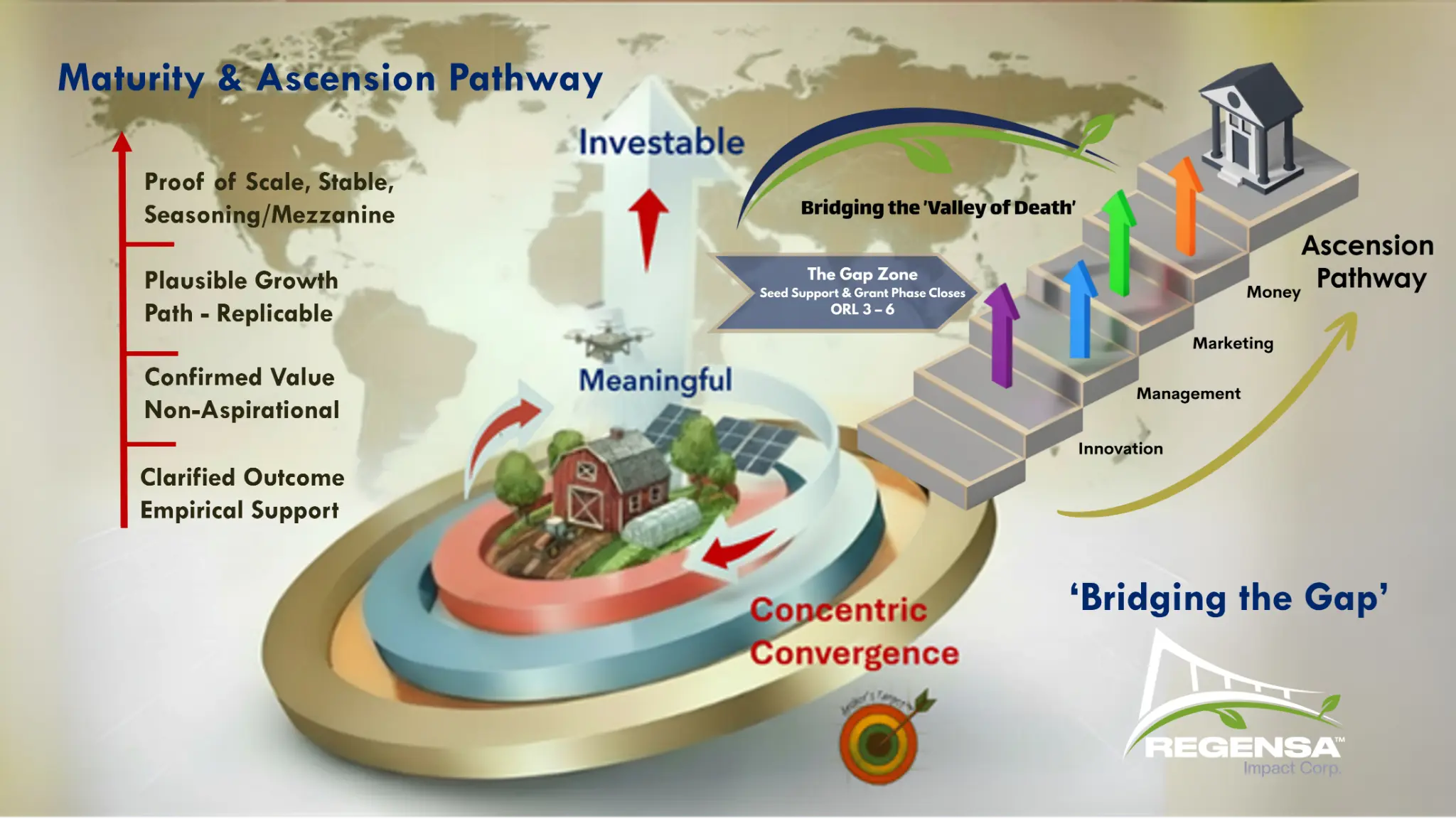
Maturity & Ascension Pathway
Once an opportunity is Meaningful (typically ORL 3–4), we orchestrate a staged maturity sequence — clarified outcomes, confirmed value, plausible growth path, and proof of scale — to move it toward full investability.
Staged Capital Strategy
Activating the Capital Cascade
From philanthropic grants and concessional capital through catalytic and impact-aligned funding to commercial-institutional finance — each stage de-risks the next, building the bridge across the Valley of Death.
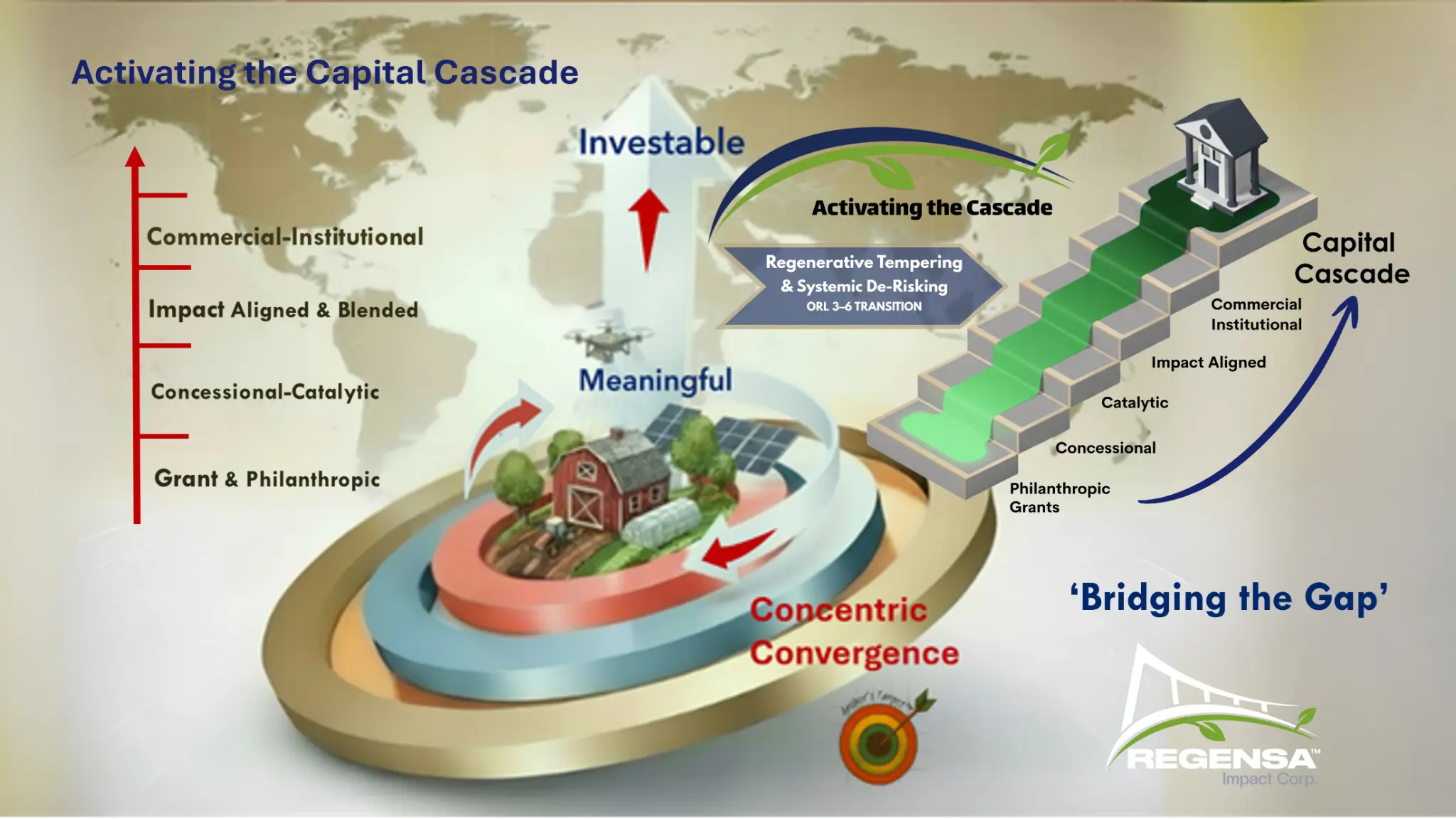
Patient, flexible funding that absorbs early risk and allows the opportunity to prove core assumptions.
Blended or impact-first capital that bridges from proof-of-concept to proof-of-model.
Strategic endorsements and co-investment from recognized institutions that signal credibility.
Traditional debt, equity, or revenue-based financing that scales proven models at market rates.
The farm is ready. Now meet the system that feeds it.
Explore Agri4ge®